
What is web development?
Web development is the building of anything that runs in a browser. That is a wide range. At one end is a ten-page company website whose job is to explain what you do and collect enquiries. At the other is a web application such as a booking system, a customer portal or an internal dashboard, where people sign in and get work done. In between sit online stores, membership sites, directories and learning platforms. The skills overlap, but the planning is different for each, so the first task in any project is to be clear about which of these you are building.
Every web project has a front end and a back end. The front end is what visitors see and touch: layout, text, images, menus and forms, written in HTML, CSS and JavaScript. The back end is what they do not see: the server, the database and the code that stores an order or checks a password. Many sites also have a content management system, or CMS, which lets your own staff change pages and add products without a developer.
The choice of platform matters more than most buyers expect. WordPress suits content-led sites that marketing teams update daily. Shopify suits most stores because payments, tax and hosting are handled for you. A custom build in a framework such as Laravel, Django or Next.js suits products with their own logic, where an off-the-shelf platform would have to be bent out of shape. Picking a platform because a developer happens to know it is one of the most common and most expensive mistakes.
A site that looks good is not the same as a site that works. It has to load quickly on a mid-range phone, because slow pages lose visitors and rank lower in search. It has to be usable by people who navigate with a keyboard or a screen reader, which in many countries is a legal requirement. It has to be secure, kept up to date and backed up. And it has to be found, which means clean page structure, sensible addresses and the structured data that search engines and AI assistants read.
Finally, a redesign is not a fresh start. If your current site receives visits from search, every old address must point to its new equivalent on launch day. Skipping that step is the usual reason traffic falls after a redesign. A careful team treats the move itself as part of the project, working alongside SEO from the first site map.
How we deliver a web project, step by step
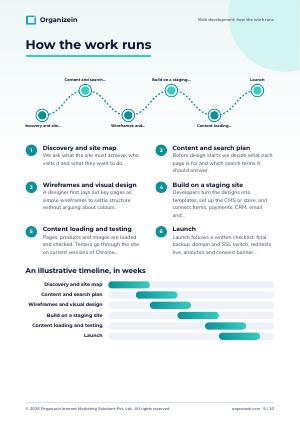
A brochure site and a customer portal are different sizes of job, but both pass through the same seven stages at Organizein. A small site completes them in six to eight weeks. A store with a large catalogue or a web app with accounts and payments takes longer, mainly in the build and test stages. From the fourth stage you have a private staging address where you can see the real site taking shape.
Discovery and site map
We ask what the site must achieve, who visits it and what they want to do. We review your current site, its analytics and two or three competitors. The output is a site map listing every page type, a feature list and a fixed-price scope. For web apps this stage also produces the user roles and the main workflows.
Content and search plan
Before design starts we decide what each page is for and which search terms it should answer. For a redesign we crawl the existing site and build a redirect map, so every old address has a new home. We also agree who writes the text. If you need it, our website copywriting team drafts it.
Wireframes and visual design
A designer first lays out key pages as simple wireframes to settle structure without arguing about colours. Then the home page and two or three inner pages are designed in full, for phone and desktop, using your brand. Once you approve those, the remaining templates follow the same system.
Build on a staging site
Developers turn the designs into templates, set up the CMS or store, and connect forms, payments, CRM, email and analytics. Work is published to a private staging site that you can open at any time. Every change is reviewed by a second developer, and code is kept in a repository you have access to.
Content loading and testing
Pages, products and images are loaded and checked. Testers go through the site on current versions of Chrome, Safari, Firefox and Edge, on phones and tablets, with a keyboard only and with a screen reader. Page speed is measured against Core Web Vitals, and forms and payments are tested end to end.
Launch
Launch follows a written checklist: final backup, domain and SSL switch, redirects live, analytics and consent banner working, site map submitted to search engines, and a crawl to catch broken links. We launch at a quiet hour for your audience and watch error logs and search data closely for the next two weeks.
Care and improvement
After launch a site needs security updates, backups, uptime checks and small changes. You can take a monthly maintenance and support plan, or we hand over to your team with a recorded training session and written notes for editors.
Who works on your site
A typical team is a project lead, a designer, one or two front-end developers, a back-end developer and a tester, with an SEO specialist and a copywriter joining when the scope includes them. The project lead is your single contact from the first call to launch. You know the names of the people on your project before work starts.
How we keep you informed
You get a shared task board, a written update each week and a short review call every one or two weeks, where we walk through the staging site together. Feedback is collected in one place, on the page it refers to, so nothing is lost in email threads. Questions sent to the shared channel are answered within one working day.
How content and approvals work
Late content is the most common cause of late websites. We give you a content sheet that lists every page, what it needs and who owes it, with dates. Design is approved in two rounds per template, and build is approved page type by page type. That way a late change of mind affects one template, not the whole site.
Security, ownership and handover
Hosting, the domain, the CMS and every outside service are registered in your company name, with admin access for you. The contract states that designs, code and content belong to you. We sign a non-disclosure agreement on request. Fixed-price projects include a warranty period in which defects against the agreed scope are fixed at no charge.
How we handle stores and payments
For online stores we set up products, variants, tax, shipping zones and payment methods in test mode first and place test orders through every route: card, wallet, cash on delivery, discount code and refund. Order emails, invoices and stock updates are checked against what your accounts and warehouse expect to receive. Only when a full order passes cleanly from basket to books do we switch payments to live.
How we protect search traffic during a move
On a redesign we benchmark the old site before touching it: which pages bring visits, which rank and which have earned links. Those pages keep their content and, where possible, their addresses. Every other address gets a redirect that is tested before and after launch. For four weeks afterwards we compare search visits and indexed pages with the benchmark and fix any drop page by page.
What you can change yourselves
We build so that routine edits never need a developer. Editors can add pages from approved templates, reorder sections, swap images, publish posts and update products. Design rules such as fonts, spacing and colours are locked into the templates, so the site stays consistent however many people edit it.
Weeks. An illustration of a typical order of work, not a quote.

What is included in our web development service
Each part below is listed and priced separately in the scope, so you can see where the effort goes and remove what you do not need.
Discovery and site map
Goals, audience, page types and features, agreed in writing before design.
UX and UI design
Wireframes and full designs for phone and desktop, in your brand.
Front-end build
Fast, accessible templates in clean HTML, CSS and JavaScript or React.
CMS or store setup
WordPress, Shopify, WooCommerce, Magento or a custom admin, with roles for your staff.
Back-end development
Accounts, workflows, search and business logic for portals and web apps.
Integrations
Payments, CRM, email, chat, analytics, maps and your internal systems.
Migration and redirects
Content moved from the old site and every old address pointed to a new one.
Launch and training
A checklist launch, monitoring afterwards and a training session for editors.
Hosting fees, paid themes, plugins and stock photography are third-party costs. We list the ones your site needs in the quote, and you pay the suppliers directly with no margin added by us.
Who uses this service, and why
Web projects reach us from four directions. The work behind each is different, which is why we ask about your situation before we talk about pages.
Companies replacing an old site
The site is slow, hard to edit or no longer matches the business. The priority is a better site without losing search traffic.
Businesses starting to sell online
You need a store with payments, shipping and tax set up correctly, connected to stock and accounts.
Teams that need a portal or tool
Customers, partners or staff must sign in to see orders, documents or reports. This is a web application, not a website.
Agencies that need build capacity
You design and sell. We build under your brand, to your standards and deadlines.
WordPress, Shopify or custom: how we choose a platform
We work on all the platforms below and have no reason to push one. The right choice follows from who will update the site, what it must connect to and how unusual your requirements are.
| Question | WordPress | Shopify | Custom build |
|---|---|---|---|
| Best for | Content-led sites and blogs | Most online stores | Portals and web apps with their own logic |
| Who updates it | Marketing staff, daily | Store staff, daily | Staff through a custom admin |
| Hosting | You choose and manage it | Included | Cloud hosting we set up |
| Running costs | Hosting, plugins, upkeep | Monthly plan and app fees | Hosting and maintenance |
| Main risk | Too many plugins | Limits on checkout and data model | Higher first cost |
When a project outgrows these, for example a product with subscriptions and many customer accounts, it becomes SaaS product development or custom software, and we plan it that way from the start.
What decides the cost and timeline of a website
A website quote is built from the site map and feature list. Two sites with the same number of pages can differ widely in effort. These are the things that move the price most. The pricing page explains how fixed quotes are structured.
- The number of page templates, not the number of pages. Fifty pages on five templates is a small job.
- Whether the design is fully custom or adapted from a proven theme.
- E-commerce: catalogue size, variants, shipping rules, tax and the number of payment methods.
- Sign-in areas, roles and workflows, which turn a website into an application.
- Integrations with CRM, ERP, stock or booking systems, and how well those systems are documented.
- Content: how much must be written, rewritten, translated or migrated.
If the budget is fixed, launch with fewer templates and add sections later. A small site that is fast, clear and complete does more for a business than a large one with unfinished pages.
What we measure after launch
A site is a tool, and tools are judged by results. We agree these measures with you before launch and report them monthly if you take a care plan.
Core Web Vitals
Loading, responsiveness and visual stability as measured for real visitors.
Enquiries and sales
Form submissions, calls and orders, with the page and source each came from.
Conversion rate
The share of visitors who take the action the page was built for.
Organic visits
Traffic from search, compared with the old site after a redesign.
Accessibility issues
Problems found by automated scans and manual checks against WCAG.
Uptime and errors
Availability of the site and the number of broken pages or failed forms.
Mistakes we see in web projects
The same few problems appear in most of the sites we are asked to rescue. All of them are decided early, long before any code is written.
Designing before the content exists
Layouts built around placeholder text break when the real text arrives. Plan content first.
Launching without redirects
Old addresses that lead nowhere lose rankings and frustrate returning visitors.
Choosing a platform by habit
A blog engine stretched into a store, or the reverse, costs more every year it runs.
Adding plugins for everything
Each plugin is code someone else maintains. Too many make a site slow and fragile.
Treating launch as the end
Without updates and backups a site becomes a security risk within months.
The first 90 days after launch
Launch day is the start of a site's useful life, and the first three months decide how well it performs. In the first two weeks we watch for errors, broken links and failed forms, and compare search visits with the old site. In the first month we look at how real visitors move through the key pages and adjust headings, buttons and forms that underperform.
By the third month there is enough data to judge the site against the goals set in discovery. We hold a review call, show the figures for enquiries, sales and speed, and agree a short list of improvements. Clients on a care plan get that review every quarter. Clients who manage the site themselves receive the same checklist so their own team can run it.
What to prepare, and what to ask any web developer
A clear brief shortens every web project and makes quotes comparable. The first list is what we ask every client for. The second is what we suggest you ask us and anyone else you are considering.
What to prepare before you ask for a quote
- The address of your current site and access to its analytics, if you have them.
- A list of the pages or sections you know you need, and the three sites you like most.
- Your logo, colours, fonts and any photography you own.
- The systems the site must connect to, such as CRM, payments, stock or booking.
- Who on your side will supply text and approve designs, and how quickly.
- Any legal needs: cookie consent, accessibility standard, languages and regions.
Questions to ask any provider
- Will we see the site on a staging address during the build, and from which week?
- Who writes the content, and is migration of the old content included?
- How will redirects from the old site be handled and tested?
- Which speed and accessibility standards will the site be tested against?
- In whose name are hosting, domain and licences registered?
- What is covered after launch, and what does ongoing care cost?
Terms used on this page
Web projects come with their own vocabulary. These are the words that appear in our scopes and reports, explained in plain language.
- Front end
- The part of a site that runs in the visitor's browser: layout, text, images and interaction.
- Back end
- The server-side code and database that store data and apply business rules.
- CMS
- A content management system, software that lets non-developers edit a site.
- Staging site
- A private copy of the site where work is reviewed before it goes live.
- Redirect
- An instruction that sends visitors and search engines from an old address to a new one.
- Core Web Vitals
- Google's measures of how fast and stable a page feels to real visitors.
Questions about web development
How long does it take to build a website?
A small company site usually takes six to eight weeks. Stores and web apps take longer, depending on catalogue size, integrations and how quickly content arrives.
How much does a website cost?
Price follows the number of templates, the design approach, e-commerce needs and integrations. You get a fixed quote against a written scope after a short call.
Which platform should we use?
WordPress for content-led sites, Shopify for most stores, and a custom build when your requirements do not fit either. We recommend one after learning how you work.
Will a redesign hurt our search rankings?
Not if the move is planned. We map every old address to a new one, keep page titles and content that perform, and monitor search data after launch.
Can you redesign our site without changing the platform?
Yes. If the current platform suits you, we can rebuild the theme and templates and keep your content, users and integrations in place.
Do you write the content?
We can. Our copywriters draft pages from interviews with your team. If you write it yourselves, we supply a content sheet with what each page needs.
Will the site work on phones?
Yes. Every template is designed for phones first and tested on real devices and tablets as well as desktop browsers.
Is the site accessible?
We build and test against WCAG guidelines, including keyboard use, contrast and screen readers, and report anything that still needs a content decision from you.
Can we edit the site ourselves?
Yes. Your staff get editor accounts, a training session and written notes. Routine changes to text, images and products need no developer.
Do you provide hosting?
We set up hosting in your name with a provider that suits the site, or work with your existing host. You keep full admin access.
Can you connect the site to our CRM?
Yes. Enquiry forms, orders and sign-ups can be sent to systems such as HubSpot, Salesforce or Zoho, or to your own software through an API.
Do you build online stores?
Yes, on Shopify, WooCommerce and Magento, including payments, shipping rules, tax, stock sync and product import.
Can you build a web application, not only a website?
Yes. Portals, dashboards and booking systems with accounts and workflows are built in frameworks such as Laravel, Django, Node.js and React.
Who owns the site?
You do. Designs, code, content, domain and hosting accounts are all in your company name, and this is written into the contract.
Do you sign an NDA?
Yes, on request, before you share any plans, data or access.
What happens after launch?
We monitor the site for two weeks. After that you can take a monthly care plan for updates, backups and changes, or manage it yourselves.
Can you fix or speed up our existing site?
Yes. We start with an audit of speed, security and code quality, then give you a fixed quote for the repairs worth making.
Do you work with agencies?
Yes. We build under your brand and to your process, and we do not contact your clients unless you ask us to.
Can you make the site multilingual?
Yes. We set up language versions with correct addresses and tags for search engines, and can arrange translation.
How do we get a quote?
Send the form on this page with your current site and what you need. We reply with questions, then a written scope, timeline and price.
A ten-page guide to web development
Further reading
Related services and reading
Guides
How Much Should a Website Cost?
Are you thinking of redesigning your already existing website or simply wish to launch a new one?
What Is CRM
Best Interaction services with Customers.
What Is Digital Marketing
Build Brand Recognition as an Industry Leader and Enhance Profitability
Further reading
Independent sources on the standards and platforms behind this work.