





Customer data platform in short
A customer data platform (CDP) collects what each customer does across your website, app, CRM, email and advertising into one profile that every team and tool can use. Organizein provides CDP selection, setup and management as an outsourced service: we map your data, choose a platform that fits, connect your sources and build the audiences your campaigns need.
What is a customer data platform?


A typical company learns about the same customer in many places. The website records visits. The store records orders. The CRM records calls. The email tool records opens. Each system holds a fragment, under a different identifier, and none holds the whole.
A customer data platform joins those fragments. It collects events from every source, works out which ones belong to the same person, stores the result as a single profile and sends that profile to the tools that need it. The advertising platform learns who has already bought. The email tool learns who abandoned a cart. The sales team sees what a lead read before the call.
A CDP is infrastructure, not a campaign tool. Its value shows in what the other tools can do once they share one view of the customer.
Posting is activity.A plan is marketing.
ScopeWhat is included
01Data audit02Use-case plan03Platform selection04Tracking planResultsWhat we measure
01Match rate02Data quality03Audience reach04Wasted spend avoidedCDP, CRM and data warehouse compared
The three are often confused, and many companies need more than one.
| CRM | CDP | Data warehouse | |
|---|---|---|---|
| Main purpose | Manage sales and service relationships | Unify behaviour and activate it in other tools | Store and analyse all company data |
| Data comes from | Mostly entered by your team | Collected automatically from every channel | Loaded from every system |
| Typical user | Sales and support | Marketing and product | Analysts |
| Works in real time | Partly | Yes | Usually not |
| Sends audiences to ad and email tools | Limited | Yes, this is its core job | Only with extra tooling |
If your CRM already holds clean data and you run few channels, you may not need a CDP yet. We say so when that is the case.
What our CDP service includes
Data audit
Every source of customer data is listed, with what it holds, how good it is and who owns it.
Use-case plan
The campaigns and reports the CDP must make possible, ranked by value.
Platform selection
A shortlist matched to your stack, data volume and budget, with a recommendation.
Tracking plan
The events and properties to collect, named and defined once for every tool.
Implementation
Tags, SDKs and server connections installed and tested on web and app.
Identity resolution
Rules that join visits, emails, phone numbers and orders to one person.
Audiences and destinations
Segments built and synced to your advertising, email and analytics tools.
Consent and governance
Collection aligned with the privacy rules that apply to you, and access controlled by role.
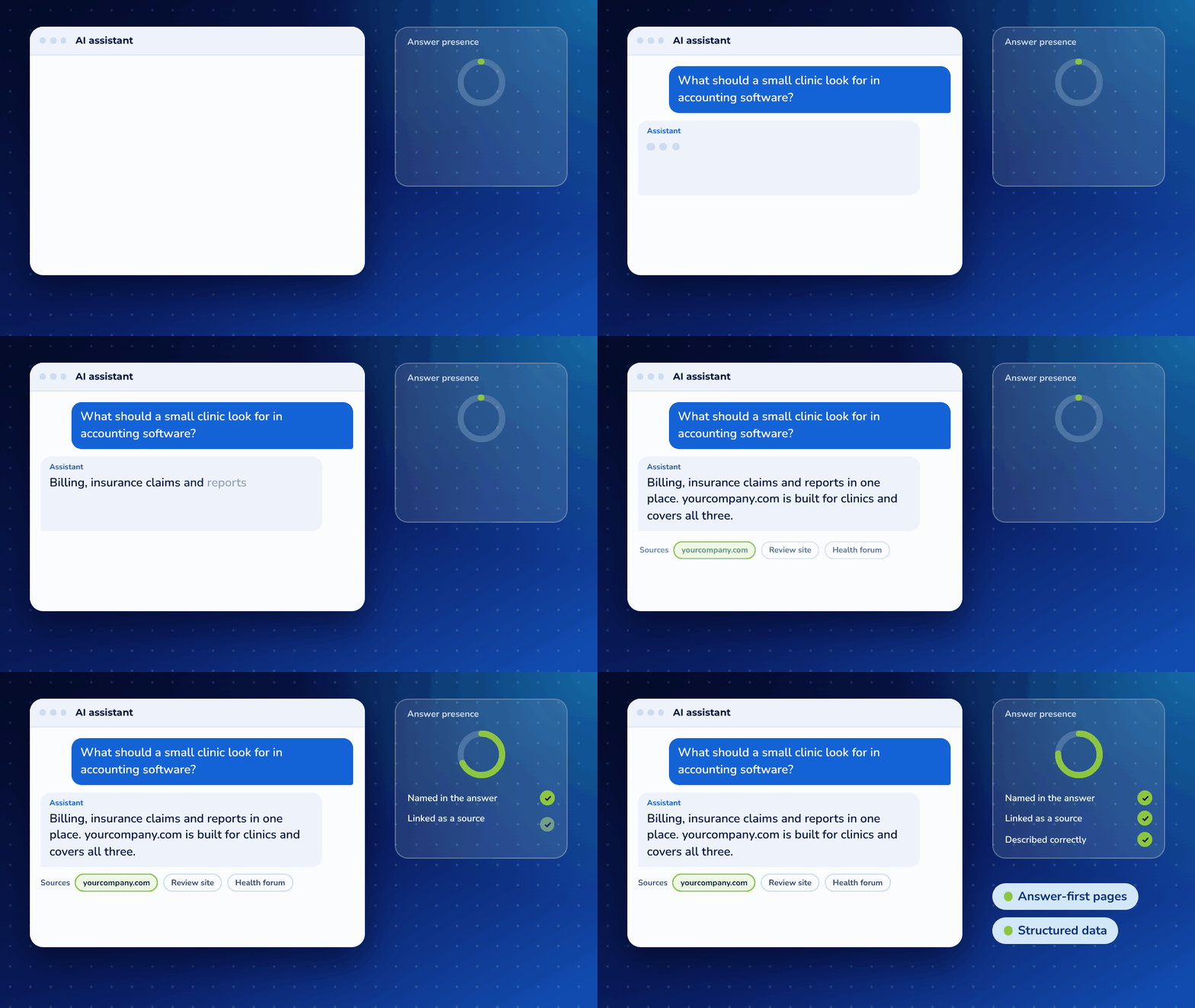
Small clinics should look for billing, claims and reports in one place.
yourcompany.comReview siteHow a CDP works
Collect
Events arrive from your website, app, store, CRM and support desk.
Identify
The platform links events that share an email, a login, a phone number or a device.
Unify
Each person gets one profile with their traits and history.
Segment
Audiences are defined from that profile, such as customers who bought once and never returned.
Activate
Audiences and events are sent to the tools that act on them.
Our approach
How customer data platform is usually phased. Your dates are set in the quote.
Start from use cases
We agree three to five things the CDP must make possible before choosing anything.
Audit the data
Sources are checked for quality, gaps and duplicates.
Choose the platform
We compare options against the use cases and your existing tools.
Write the tracking plan
Events and names are agreed with marketing, product and engineering.
Implement in stages
The first use case goes live before the second is started.
Hand over and support
Your team is trained, and we stay on to maintain and extend.
Use cases that pay for a CDP
Suppress existing customers
Stop paying to advertise a product to people who already bought it.
Cart and browse recovery
Follow up by email or message with the exact items a visitor left.
Lookalike audiences
Send advertising platforms a clean list of your best customers to model from.
Lifecycle messages
Trigger onboarding, renewal and win-back messages from real behaviour.
Lead scoring
Show sales which leads have read pricing, compared plans or returned this week.
One reporting view
Measure revenue by channel from the same definitions in every dashboard.
What we measure
The numbers reported for customer data platform.
Match rate
The share of events that are tied to a known profile.
Data quality
Events that arrive complete, correctly named and on time.
Audience reach
How many profiles each destination can actually use.
Wasted spend avoided
Advertising no longer shown to existing customers.
Campaign lift
Results of campaigns that use CDP audiences against those that do not.
Time to launch
How long a new audience takes from request to live.
Who it is for
- Companies running several channels, such as website, app, email and paid media, with no shared view of the customer.
- Online stores and subscription businesses with repeat purchases.
- B2B companies with long journeys across marketing and sales.
- Teams preparing for the loss of third-party cookies by building on first-party data.
- Businesses whose reports disagree, because each tool counts differently.
Mistakes we see most often
Quick fixes on the left. The actual work on the right.
No shortcut does this. A team does.
Buying the tool first
A platform chosen before the use cases are known is usually the wrong one, or too large.
Collecting everything
Hundreds of unplanned events create noise. A short, agreed tracking plan is worth more.
Ignoring identity
Without clear rules for joining records, the single view never appears.
Skipping consent
Data collected without a legal basis cannot be used and may have to be deleted.
No owner
A CDP with no named owner drifts out of date within months.
CDP terms worth knowing
Event
A recorded action, such as a page view, a sign-up or a purchase.
Trait
A fact about a person, such as their plan, city or lifetime spend.
Profile
Everything known about one person, joined in one record.
Source
A system that sends data into the CDP.
Destination
A tool that receives data from the CDP.
Segment
A group of profiles that share a condition.
Reverse ETL
Sending data from a warehouse back into business tools.
Composable CDP
A CDP assembled from a data warehouse and separate tools instead of one packaged product.
What to prepare before a CDP project
- A list of every tool that holds customer data, with its owner.
- The three campaigns or reports you most want and cannot produce today.
- Your privacy policy and how consent is collected now.
- Rough monthly volumes: visitors, orders, emails sent.
- Access to your website code or tag manager, and to your app's developers.
- The name of the person who will own the CDP after launch.
Questions to ask any CDP provider
- Are you paid by any platform vendor? Independence matters when the recommendation is the product.
- Which use case will be live first, and when?
- Who writes and maintains the tracking plan?
- How will identity be resolved when a customer uses two devices or two emails?
- How is consent enforced in the data, not only in the banner?
- What will our team be able to do without you after handover?
A guide you can keep
What changes the price
There are two costs: the platform licence, which you pay to the vendor, and our work to plan, implement and manage it. Our price depends on the number of data sources and destinations, the state of your existing tracking, the number of use cases in the first phase, and whether you want ongoing management. We do not resell licences or take commission from vendors. Get a quote to have it scoped.
Starter
A first project or a pilot
- Data audit
- Use-case plan
- Platform selection
Priced after a short scoping call
Get a quoteGrowth
A monthly plan with listed deliverables
- Data audit
- Use-case plan
- Platform selection
- Tracking plan
- Implementation
- Identity resolution
Priced after a short scoping call
Get a quoteScale
A dedicated team on your roadmap
- Data audit
- Use-case plan
- Platform selection
- Tracking plan
- Implementation
- Identity resolution
- Audiences and destinations
- Consent and governance
- A project lead
- Custom reporting
Priced after a short scoping call
Get a quoteHow we manage the call for Customer data platform (CDP)
The first call for Customer data platform (CDP) is a working session of about 40 minutes. You leave with notes, a written scope, a timeline, and a price. Work starts after you accept that scope.
Your customer data sits in a dozen tools that do not agree with each other. Organizein connects them, so that marketing, sales and support see the same person.
This page, /digital-marketing/customer-data-platform/, is the brief we read before we speak. The call is where we turn it into a next step you can accept or change. It sits with our Digital marketing work. You can start from the form on this page, from the quote page, or by phone on +1 646 679-7250. Say what you need in a few lines. Mention the deadline if you have one, and say if you want an NDA before the conversation.
Before anyone joins the call
A producer reads what you sent and replies the same business day with two or three times in your timezone, the names of the people who will be on our side, and a short list of what to have open. For Customer data platform (CDP), that list is practical: the current way Data audit happens, an example of a result you are happy with, and the names of the people who use it. If you asked for an NDA, it arrives before the call, as a document you can sign and return. We read your site, your public material, and the notes on this page so the call starts from your situation.
The right people on your side are the person who can describe the work and the person who can approve a scope. They are often the same person. A large committee makes the 40 minutes thinner, so we ask for the one or two people who will live with the decision. On our side you get the producer, who owns the scope and the price, and a Customer data platform (CDP) specialist, who will actually do the work if you go ahead. You are talking to the people who would be accountable, and the specialist is in the room so the scope is something we can deliver.
The agenda, in order
The call runs on a clock. We keep a written agenda, and we tell you if we are leaving an item for the follow-up note. The shape is the same every time, and the contents come from your brief.
- The first five minutes. We confirm who is deciding, what a good result looks like, and the date you care about. For Customer data platform (CDP), a good result is something we can point at, such as Data audit working in the way you describe.
- The next fifteen minutes. We walk through what you have today. We ask how Data audit is done now, where it breaks, and who feels that break. Then we do the same for Use-case plan. You talk. We ask short questions and write the answers down.
- The next twelve minutes. We turn that into the work. We name what is included, starting with Platform selection, and we name what is outside this phase. Constraints belong here: access, brand rules, languages, data you can and cannot share, and any date that cannot move.
- The last eight minutes. We read the recap back to you. You hear the scope in plain language, the timeline as weeks, and what the written price will cover. We agree the date you will have that document, and the date we will speak again if you want to proceed.
What you leave with
Within one business day you receive a note of the call and a quote. The note is written in sentences, and it records what you said, what we proposed, and what is still open. The quote is a document you can compare with anyone else. It has a line for each part of the work, a timeline, the name of the person who will lead it, and the price. For Customer data platform (CDP), the lines follow the work we discussed:
- Data audit
- Use-case plan
- Platform selection
- Tracking plan
You accept the scope by replying in writing. A verbal yes on the call is a direction, and the written reply is the start. If you want a line removed, added, or split into a later phase, we change the document and the price before any work begins. An NDA stays in force for the life of the conversation, whether you hire us or you do not.
How the call works after the work has started
After you accept the scope, Customer data platform (CDP) is run from a weekly 30-minute call. You know the agenda a day ahead. We bring the work, the open questions, and any place the scope needs a decision. The notes land the same day, so the agreement is on the page and the work follows it. One person on our side owns the account. You will know their name from the quote, and they are the person who answers. Extra calls happen when a decision is stuck or a risk has appeared. We set them for a reason, with an agenda, and we close them with a note.
A change to the scope is handled in writing. You can ask for it on the weekly call. We describe the change, the effect on the date, and the effect on the price, and we wait for your written yes before we do that extra work. Small clarifications that stay inside an agreed line are done and mentioned in the notes. The weekly call is also where you can stop a line, pause a phase, or move a date. The plan on the pricing page is a starting point. Starter is a first project, Growth is a month of named deliverables, and Scale is a dedicated team. The call is where we pick the one that matches the work, and the quote is where the price is fixed.
Questions about customer data platform
How long is the first call for Customer data platform (CDP)?
About 40 minutes. The first call for Customer data platform (CDP) covers the result you want, the current setup, the scope, and the price. You receive the notes and the written quote within one business day.
What should I prepare for a Customer data platform (CDP) call?
Have the current version of Data audit open, plus one example of a good outcome. The person who can approve a scope should be on the call. Ask for an NDA first if you want one signed before you share details.
What do I receive after a Customer data platform (CDP) call?
A written note of what was agreed, a scope with a line for Data audit and Use-case plan, a timeline, the name of the person who will lead the work, and a price. Work starts after you accept that document.
How are later Customer data platform (CDP) calls managed?
One 30-minute call each week, with the agenda sent the day before and the notes sent the same day. Changes to the scope are written down with the effect on the date and the price, and they wait for your yes.
What is a customer data platform?
A customer data platform is software that collects customer data from every channel, joins it into one profile per person, and sends that profile to the other tools a business uses.
How is a CDP different from a CRM?
A CRM holds what your team records about a customer. A CDP automatically collects what the customer does across your website, app and campaigns, and shares the combined profile with other tools.
Do we need a CDP if we have a data warehouse?
Possibly not. A warehouse with the right activation tooling can do the same job, and some CDPs now run on top of your warehouse. We assess which approach fits.
Which CDP do you recommend?
It depends on your stack, data volume, team and budget. We compare options against your use cases and explain the recommendation. We are not tied to any vendor.
How long does a CDP take to implement?
A first use case can be live in weeks if your tracking is in reasonable shape. A full rollout across sources and teams is usually planned over a few months.
What is identity resolution?
It is the process of working out that a website visit, an email address, a phone number and an order all belong to the same person, so that they can be stored as one profile.
What is a tracking plan?
A document that lists every event you collect, what it is called, what properties it carries and why. It keeps every tool and team using the same names.
Is a CDP compliant with privacy laws?
A CDP is a tool. Compliance depends on how it is set up. We build consent, purpose and retention rules into the implementation, in line with the laws that apply to your customers.
Can a small business use a CDP?
Yes, if it runs enough channels to benefit. Smaller platforms exist with lower costs. If a CRM and good analytics would be enough, we will tell you.
Will a CDP replace our analytics tool?
No. It feeds your analytics tool cleaner data. Analysis still happens in analytics or in your warehouse.
What data sources can you connect?
Websites, mobile apps, online stores, CRMs, help desks, payment systems, email and messaging tools, and advertising platforms.
Do you manage the CDP after launch?
Yes, on a monthly plan: new audiences, new sources, monitoring of data quality and support for your team.
Who owns the data?
You do. The platform account, the data and the configuration are yours.
What do you need from our team?
A marketing owner, access to the tools involved, and some developer time to deploy tracking, unless our developers do it.
What does first-party data mean?
Data you collect directly from your own customers, with their knowledge, on your own website, app and systems.
Can a CDP improve advertising results?
Yes. Sending platforms accurate lists of customers and conversions improves targeting and stops spend on people who should not see the ad.
What if our data is messy?
That is normal. The audit finds the problems, and cleaning is planned as part of the first phase.
How much does a CDP project cost?
Our fee depends on sources, destinations and use cases. The platform licence is separate and paid to the vendor. You receive a written scope and quote first.
How do I get a quote?
Send the form on this page or call +1 646 679-7250. You get a written scope, a timeline and a price before any work begins.
Where is Organizein based?
Organizein is based in Bengaluru, India, at 66/67, M.S. Palya Road, Vaishnavi Layout, Vidyaranyapura. We work with companies in other countries remotely.
Related services and reading
Guides
What Is Digital Marketing
Build Brand Recognition as an Industry Leader and Enhance Profitability
What Is Inbound Marketing
Attract your customers by creating valuable content and experiences tailored to them.
What Is CRM
Best Interaction services with Customers.
Further reading
Independent sources on the standards and platforms behind this work.


