






Enterprise platform services company in short
Organizein is an enterprise platform services company based in Bengaluru, India. Implementation, customisation and support for SAP, Oracle, Dynamics, Salesforce, HubSpot, Zoho, ServiceNow, Workday and Microsoft 365.
Enterprise platform services company: what we cover
Implementation, customisation and support for SAP, Oracle, Dynamics, Salesforce, HubSpot, Zoho, ServiceNow, Workday and Microsoft 365.
Enterprise platforms
A guide to enterprise platform work you can keep


See the work in motion
A short animation of the kind of result this work produces, using sample data.
Why outsource enterprise platform work?
Code gets it built.Process gets it shipped.
ScopeWhat is included
01Discovery02Design03Build04TestResultsWhat we measure
01Velocity02Defect rate03Load time04UptimeA full team from day one
A product needs design, front end, back end, testing and DevOps. Outsourcing provides the whole team without hiring each role.
A faster start
The team, tools and process already exist, so work begins in days.
Flexible size
Add people for a big release and reduce afterwards.
Lower fixed cost
You pay for the work done, not for recruiting, benefits and idle time.
How outsourcing enterprise platform work works, step by step
How enterprise platform work is usually phased. Your dates are set in the quote.
Discovery
We agree goals, users, scope and budget, and write them down.
Design
User flows, wireframes and a clickable prototype show the product before code is written.
Build
Development runs in short cycles with a demo at the end of each.
Test
Automated and manual tests cover features, devices, speed and security.
Launch
We release to production or the app stores and watch the first days closely.
Support
Fixes, updates and new features continue under a support plan.
What you receive when you outsource enterprise platform work
Every engagement lists its deliverables in writing. These are the usual ones.
Written scope and estimate
Wireframes and prototype
Source code in your repository
Test reports
Deployment scripts and environments
Technical documentation
Admin training
Support plan
Plans for enterprise platform work
Plans are a starting point. The scope and the price are set for you after a short call.
Starter
A first project or a pilot
- Written scope and estimate
- Wireframes and prototype
- Source code in your repository
Priced after a short scoping call
Get a quoteGrowth
A monthly plan with listed deliverables
- Written scope and estimate
- Wireframes and prototype
- Source code in your repository
- Test reports
- Deployment scripts and environments
- Technical documentation
Priced after a short scoping call
Get a quoteScale
A dedicated team on your roadmap
- Written scope and estimate
- Wireframes and prototype
- Source code in your repository
- Test reports
- Deployment scripts and environments
- Technical documentation
- Admin training
- Support plan
- A project lead
- Custom reporting
Priced after a short scoping call
Get a quoteTools and technology for enterprise platform work
We work with the tools you already have and add what the job needs. These are the ones we use most often.
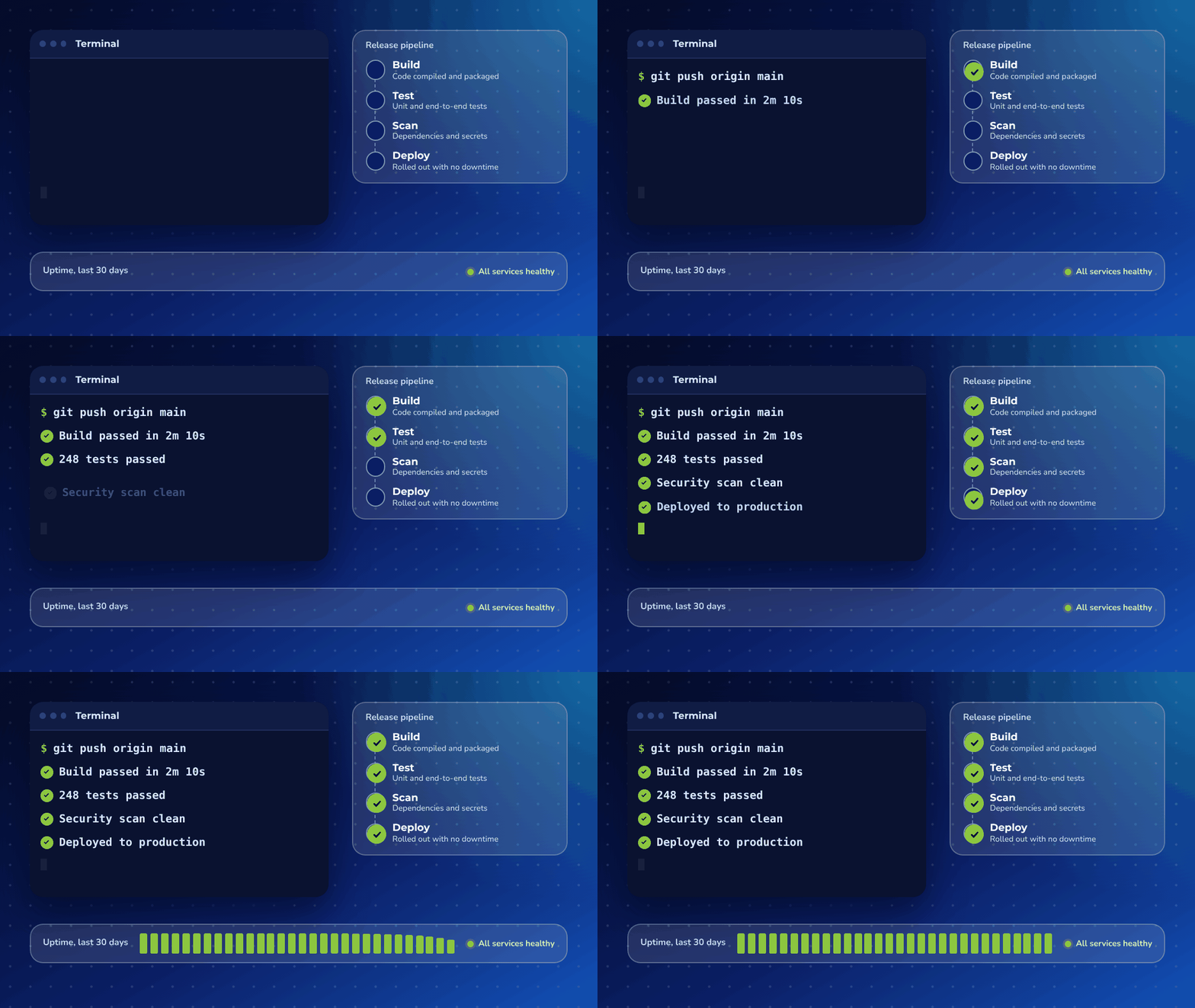
What we measure and report
The numbers reported for enterprise platform work.
Velocity
The amount of work completed in each cycle.
Defect rate
Bugs found after release.
Load time
How fast screens appear for users.
Uptime
The share of time the product is available.
Adoption
How many users use each feature.
Crash-free sessions
The share of app sessions without a crash.
Common mistakes with enterprise platform work
Quick fixes on the left. The actual work on the right.
No shortcut does this. A team does.
Starting without a written scope
Vague requirements are the main cause of overruns.
Building everything at once
A smaller first release reaches users sooner and teaches you what to build next.
Skipping tests
Bugs found by customers cost more than bugs found before release.
No plan for after launch
Software needs updates, monitoring and fixes from the first day.
A checklist before you outsource
- Write down the problem and who has it
- List must-have and nice-to-have features
- Collect examples of products you like
- Set a budget range and a deadline
- Decide who makes decisions on your side
- List the systems it must connect to
Terms worth knowing
- MVP
- Minimum viable product, the smallest version that delivers value.
- API
- An interface that lets two systems exchange data.
- Sprint
- A short, fixed cycle of development work.
- CI/CD
- Automated building, testing and releasing of code.
- Technical debt
- Shortcuts in code that make later changes harder.
- Staging environment
- A copy of the product used for testing before release.
How outsourcing works
Engagement models, the first 30 days, communication across time zones, security and contracts apply to every service, so they are explained once, in our IT outsourcing guide.
Services
Every Organizein service in one place: AI, software, cloud and data, digital marketing and dedicated teams.
Hire a team
Dedicated developers, added specialists or a full offshore team, on the engagement model that fits your…
Get a quote
Tell us what you need and get a written scope, timeline and price.
How we manage the call for Enterprise platform
The first call for Enterprise platform is a working session of about 40 minutes. You leave with notes, a written scope, a timeline, and a price. Work starts after you accept that scope.
Implementation, customisation and support for SAP, Oracle, Dynamics, Salesforce, HubSpot, Zoho, ServiceNow, Workday and Microsoft 365.
The conversation starts from this page, /platforms/, and ends in a document. You should be able to read that document and know exactly what happens next. It sits with our Services work. You can start from the form on this page, from the quote page, or by phone on +1 646 679-7250. Say what you need in a few lines. Mention the deadline if you have one, and say if you want an NDA before the conversation.
Before anyone joins the call
A producer reads what you sent and replies the same business day with two or three times in your timezone, the names of the people who will be on our side, and a short list of what to have open. For Enterprise platform, that list is practical: the current way the result you want happens, an example of a result you are happy with, and the names of the people who use it. If you asked for an NDA, it arrives before the call, as a document you can sign and return. We read your site, your public material, and the notes on this page so the call starts from your situation.
The right people on your side are the person who can describe the work and the person who can approve a scope. They are often the same person. A large committee makes the 40 minutes thinner, so we ask for the one or two people who will live with the decision. On our side you get the producer, who owns the scope and the price, and a Enterprise platform specialist, who will actually do the work if you go ahead. You are talking to the people who would be accountable, and the specialist is in the room so the scope is something we can deliver.
The agenda, in order
The call runs on a clock. We keep a written agenda, and we tell you if we are leaving an item for the follow-up note. The shape is the same every time, and the contents come from your brief.
- The first five minutes. We confirm who is deciding, what a good result looks like, and the date you care about. For Enterprise platform, a good result is something we can point at, such as the result you want working in the way you describe.
- The next fifteen minutes. We walk through what you have today. We ask how the result you want is done now, where it breaks, and who feels that break. Then we do the same for the way the work will be judged. You talk. We ask short questions and write the answers down.
- The next twelve minutes. We turn that into the work. We name what is included, starting with what must be true on the day it goes live, and we name what is outside this phase. Constraints belong here: access, brand rules, languages, data you can and cannot share, and any date that cannot move.
- The last eight minutes. We read the recap back to you. You hear the scope in plain language, the timeline as weeks, and what the written price will cover. We agree the date you will have that document, and the date we will speak again if you want to proceed.
What you leave with
Within one business day you receive a note of the call and a quote. The note is written in sentences, and it records what you said, what we proposed, and what is still open. The quote is a document you can compare with anyone else. It has a line for each part of the work, a timeline, the name of the person who will lead it, and the price. For Enterprise platform, the lines follow the work we discussed:
- the result you want
- the timeline
- the people who will do the work
- the price
You accept the scope by replying in writing. A verbal yes on the call is a direction, and the written reply is the start. If you want a line removed, added, or split into a later phase, we change the document and the price before any work begins. An NDA stays in force for the life of the conversation, whether you hire us or you do not.
How the call works after the work has started
The weekly call is how Enterprise platform stays on the scope you accepted. Thirty minutes, an agenda the day before, and notes the same day. We use the time for decisions and for looking at the work, and the status sits in the notes. One person on our side owns the account. You will know their name from the quote, and they are the person who answers. Extra calls happen when a decision is stuck or a risk has appeared. We set them for a reason, with an agenda, and we close them with a note.
A change to the scope is handled in writing. You can ask for it on the weekly call. We describe the change, the effect on the date, and the effect on the price, and we wait for your written yes before we do that extra work. Small clarifications that stay inside an agreed line are done and mentioned in the notes. The weekly call is also where you can stop a line, pause a phase, or move a date. The plan on the pricing page is a starting point. Starter is a first project, Growth is a month of named deliverables, and Scale is a dedicated team. The call is where we pick the one that matches the work, and the quote is where the price is fixed.
The full Enterprise platform process after the call
After you accept the quote, Enterprise platform moves one line at a time. Each line has an owner, a week on the timeline, and a result you can review on the weekly call.
The producer keeps the plan. The specialist does the work. You get one place to comment and one call a week to decide. A phase closes when its lines are met and the notes say so.
Understand the current setup
We look at how Enterprise platform is handled today, who touches it, and what a normal week contains. You show us the real workflow. We write down what is working and what is costing you time.
Agree the scope in writing
The scope names the parts of Enterprise platform included in this phase and the parts left for later. Each line has a result you can check. The price sits next to those lines.
Do the work where you can see it
You see drafts, staging, or reports as they are ready. You comment in writing. We revise against the scope, and the weekly call is where open comments get a decision.
Review it against the scope
Before we call a phase done, we walk the original lines with you. Enterprise platform is finished for that phase when each line is met or has a written reason for moving.
Hand over access and a short guide
You receive access in your own accounts, a short guide for the people who will use the work, and a support period that was named in the quote. The weekly call continues for as long as the plan says it does.
The first 30 days of Enterprise platform are for setting the rhythm. Week one is access, the working files, and the first line of the scope. The later weeks follow the timeline in the quote. At day 30 you have a written view of what is done, what is next, and whether the plan still matches the price. If it does not, we say so on that call and put the choice in the notes.
Questions about outsourcing enterprise platform work
How long is the first call for Enterprise platform?
About 40 minutes. The first call for Enterprise platform covers the result you want, the current setup, the scope, and the price. You receive the notes and the written quote within one business day.
What should I prepare for a Enterprise platform call?
Have the current version of the result you care about open, plus one example of a good outcome. The person who can approve a scope should be on the call. Ask for an NDA first if you want one signed before you share details.
What do I receive after a Enterprise platform call?
A written note of what was agreed, a scope with a line for the result you care about and the way you will judge it, a timeline, the name of the person who will lead the work, and a price. Work starts after you accept that document.
How are later Enterprise platform calls managed?
One 30-minute call each week, with the agenda sent the day before and the notes sent the same day. Changes to the scope are written down with the effect on the date and the price, and they wait for your yes.
What does an enterprise platform services company do?
Organizein is an enterprise platform services company based in Bengaluru, India. Implementation, customisation and support for SAP, Oracle, Dynamics, Salesforce, HubSpot, Zoho, ServiceNow, Workday and Microsoft 365.
How much does it cost to build software or an app?
It depends on features, integrations, design and platforms. After a discovery call you receive a written estimate, as a fixed quote or a monthly team cost.
How long does development take?
A simple website takes weeks, and a full product takes months. The plan sets out milestones so that you see working software early.
Who owns the source code?
You do. The code lives in your repository and the contract assigns ownership to you.
Can you take over a project another team started?
Yes. We begin with a code review so that we know what we are inheriting.
Do you build for iOS, Android and the web?
Yes, natively or with cross-platform tools such as Flutter, depending on the product.
How do you make sure the software is secure?
Through code review, dependency updates, access control and testing, and a penetration test where the risk calls for it.
What happens after launch?
A support plan covers monitoring, fixes, updates and new features.
Will we see progress as you build?
Yes. Each cycle ends with a demo, and you can open the task board at any time.
How do I get a quote?
Send the form on this page or call +1 646 679-7250. You get a written scope, a timeline and a price before any work begins.
Where is Organizein based?
Organizein is based in Bengaluru, India, at 66/67, M.S. Palya Road, Vaishnavi Layout, Vidyaranyapura. We work with companies in other countries remotely.
Related services and reading
Guides
How Much Should a Website Cost?
Are you thinking of redesigning your already existing website or simply wish to launch a new one?
What Is CRM
Best Interaction services with Customers.
What Is Digital Marketing
Build Brand Recognition as an Industry Leader and Enhance Profitability
Further reading
Independent sources on the standards and platforms behind this work.